King Arthur
Le Morte d'ArthurKing Arthur stands at the center of a history that turns the ordering of a kingdom into a tragedy of kinship and fate. Chosen by the sword, acclaimed by the people, and raised from the fellowship of the Round Table to imperial ambition, he brings a measure of order to a world described as anarchic. Yet his parentage is concealed from him, and that concealment makes possible a forbidden union with his half-sister and the birth of Mordred. Prosperity and conquest do not erase this beginning: the narrative presents the doom attached to it as a danger that remains hidden until the fellowship’s brightest years are already passing.
Identity and the Making of a King
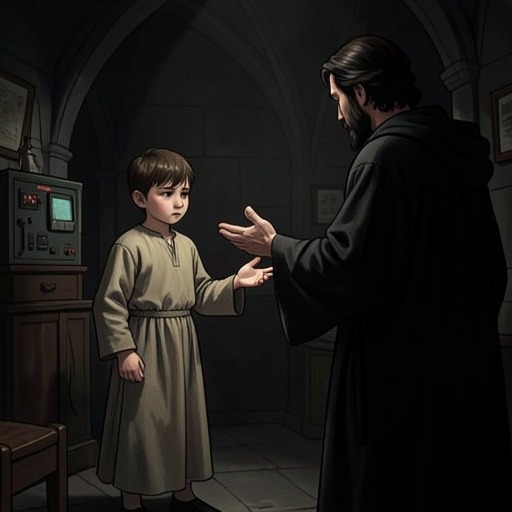
The account of Arthur’s birth, upbringing, and Uther Pendragon’s death frames his kingship as a matter of both inheritance and public proof. His origins are kept from him while he is entrusted to Sir Ector for nurture. When Arthur draws the sword that others cannot move, Sir Ector tells him that he is not his natural father and explains that Arthur was placed in his care by command. The disclosure hurts Arthur, who had regarded Sir Ector as father, even as it reveals that his standing is higher than either had supposed.
The sword’s sign becomes a public test rather than a private claim. At the feast of Pentecost, people of every rank try and fail to draw it; Arthur alone succeeds. The assembled commons call for him to be king, interpreting the event as God’s will, and kneel to ask his forgiveness for delaying him. Arthur forgives them, offers the sword upon the altar, and is crowned after swearing to rule truly and uphold justice. The sequence joins miraculous recognition to public consent and a formal obligation: the sign establishes his right, but the oath defines what his rule must be.
His bond with Sir Ector remains a consequential part of that identity. Sir Ector asks whether Arthur will be his gracious lord once crowned; Arthur answers that he owes him more than anyone in the world. The relationship is thus recast, not discarded: the man who is not his father by blood is acknowledged as the person to whom Arthur is most beholden. The concealed birth that enables the succession also leaves kinship divided between natural lineage and the care through which Arthur was raised.
Rule, Fellowship, and Public Duties
Arthur’s kingship is tested early by a realm in which powerful lords contend for rule. After Uther’s death, the land stands in jeopardy as rival magnates strengthen themselves and many expect to become king. The account of Arthur’s accession answers this political disorder with a gathering of lords and armed men at London, the sword’s public sign, and a coronation oath. Royal authority is represented not simply as force but as a settlement that asks the realm to recognize a rightful ruler.
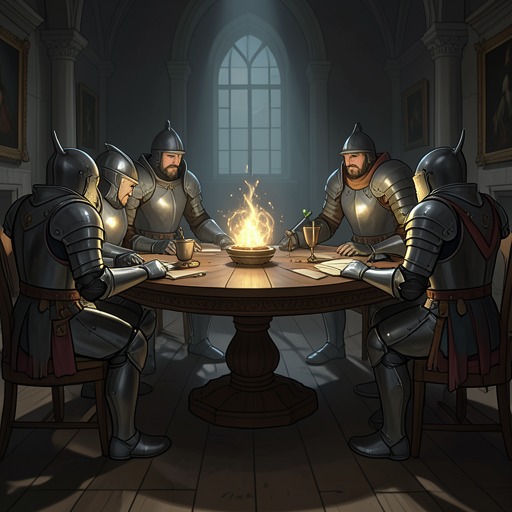
Once established, Arthur relies on the fellowship of the Round Table to turn disorder into a wider political order. The book’s retrospective account credits him and his knights with bringing universal anarchy under control, extending his power across England, Wales, and Scotland, and eventually making him emperor through his march on Rome. His authority grows from domestic kingship to leadership over other realms and the chivalry of Christendom. The scale of this achievement gives the later collapse its weight: the fellowship and its king seem to have risen beyond ordinary adversity before their strengths are tested by a different standard.
Arthur also defines his rule through direct commands to his knights. After several quests have concluded, he establishes their conduct and provides lands for those whose resources are limited. They are charged not to commit outrage or murder, to flee treason, and not to act cruelly; mercy must be given to anyone who asks for it, at the risk of losing Arthur’s favor and lordship. They must also aid ladies and gentlewomen, with death named as the penalty for failing that duty. These requirements make the Round Table more than a company of celebrated fighters: it is an instrument for imposing a moral and political code, even though the larger narrative will show that fame and prowess cannot by themselves prevent the fellowship’s undoing.
Arthur’s Pentecost custom gives his court an open, receptive character. At the high feast he will not eat until he has heard or seen a great marvel, a practice that draws extraordinary adventures into the royal hall. At Kink-Kenadon, on the sands near Wales, Sir Gawaine spots three mounted men and a dwarf just before noon and brings their arrival to the king’s attention. The custom makes marvel part of courtly governance: Arthur’s household pauses its ordinary feast for news and encounters that may redirect the story.
His rule also depends on the judgments and loyalties of other kings and knights. When Sir Anguish of Ireland is accused of treason, Arthur and Sir Launcelot cannot attend the appointed hearing at Camelot, so Arthur assigns King Carados and the King of Scots to judge in their place. The episode shows authority operating through delegated judgment rather than the king’s presence at every dispute. In another crisis, Arthur addresses the accusation against Queen Guenever as a judge constrained by his office: he says he cannot fight the case himself and hopes that a worthy knight will answer it, rather than allow her to suffer an unjust sentence. His kingship carries personal attachments, but it also demands a public procedure he cannot simply set aside.
Family, Secrecy, and the Foretold Doom
The most consequential failure of knowledge in Arthur’s life begins in the family circle. When Arthur rides to Carlion after the departure of King Ban and King Bors, the wife of King Lot of Orkney comes to court with her four sons, including Gawaine, Gaheris, Agravaine, and Gareth. She is, though Arthur does not know it, his maternal half-sister, the daughter of Igraine. Arthur falls in love with her, and Mordred is born from their union. She remains at court for a month before departing; the narrative stresses that Arthur still does not know she is his sister.
The book’s later appraisal makes explicit the chain of causes that this concealed identity sets in motion. The story opens with Arthur’s parentage hidden from him; that ignorance leads to his illicit love for a woman whose relationship to him he does not know, and their child becomes Mordred. A prophecy warns that God is displeased and that Arthur’s sister will bear a child who will destroy him and the knights of his realm. Arthur attempts, without success, to prevent the prophecy’s fulfillment through what the account calls the only cruel deed of his life. The attempted prevention does not undo the original ignorance or remove the danger; it instead confirms how little control he can exert over the consequences once the family secret has taken effect.
A second warning concerns Arthur’s marriage to Queen Guenever and the guilty love that will arise between her and Sir Launcelot. These seeds of tragedy lie concealed through long years of prosperity, while the king and his fellowship extend their renown. The contrast matters: Arthur’s public achievements accumulate in the very period when the private conditions of his undoing remain in place. The book therefore binds political history to family knowledge. Arthur can gather realms under his rule, but he cannot govern effectively what he does not know about his own lineage or what the future holds for his household.
Campaigns, Alliances, and the Reach of the Crown
The account gives Arthur’s rule a military scale as well as a legal and ceremonial one. When five kings invade his land with a great host, their forces burn and destroy cities and castles. Arthur laments that he has not had a month’s rest since his coronation and declares that his liege people must not be destroyed through his failure to act. He calls for those willing to follow him and sends urgently for King Pellinore to gather forces. The scene makes protection of his subjects an explicit motive for war, while also showing that the newly crowned king’s authority must repeatedly be defended against armed challengers.
The campaign against Rome marks a further change in scale. At a royal feast attended by kings, princes, and Round Table knights, twelve elderly envoys arrive bearing olive branches for the emperor Lucius. They demand that Arthur acknowledge Lucius as lord and pay the tribute said to be due from Britain. Arthur rejects both the demand and the premise of Roman overlordship. He says he owes tribute to no earthly prince and claims the empire by the right of his predecessors, resolving to march to Rome and take possession. The confrontation turns a diplomatic demand into a contest over sovereignty.
Arthur prepares for that expedition through the realm’s institutions. Parliament orders the ships of the land to be gathered and made ready at Sandwich within fifteen days. Before leaving, Arthur appoints Sir Bawdwin of Britain and Sir Constantine, son of Sir Cador of Cornwall, as governors, and entrusts them with the realm and Queen Guenever. The arrangement presents imperial conquest as requiring an orderly transfer of domestic government; it also makes the queen’s separation from Arthur a visible personal cost of his campaign.
In battle, Arthur is shown not as a distant commander but as a king who enters the fighting and urges his knights onward. Against the Romans he draws Excalibur and rides toward the places where their forces most threaten his people, striking down opponents and rescuing his own side. He kills the giant Galapas, first disabling him and then beheading him. The account’s emphasis on Arthur’s personal intervention complements the broad claims of sovereignty: his rule is asserted through armies and titles, but represented in the field through the king’s own action on behalf of his forces.
Judgment, Mercy, and the Uses of Power
Arthur’s ideals are most clearly tested where law and personal loyalty meet. When Sir Mador accuses Queen Guenever of treason, Arthur says that he must remain a rightful judge and cannot himself undertake the battle for his wife. He believes the deed did not come from her and hopes that a good knight will risk his own body rather than allow her to be condemned in a wrongful dispute. The queen says she does not know how the accusation arose; Arthur asks where Sir Launcelot is, recognizing that he would be willing to fight for her. The king’s words reveal both confidence in her and an awareness that his own office limits the form his defense can take.
Sir Launcelot eventually appears in disguise, fights Sir Mador, and is recognized when he removes his helmet to drink. Arthur and Guenever thank him, and Arthur asks him to accept the king’s gratitude for the hardship he has endured. Launcelot answers that he is bound to fight in Arthur’s and the queen’s cause because Arthur gave him the honor of knighthood. The rescue temporarily restores the public order of the court, but its emotional and political structure is unstable: the same knight who protects the queen is also the lover whose relationship with her has been named as a future source of Arthur’s grief.
Arthur’s treatment of King Mark and Sir Tristram offers another example of royal power used to reconcile rather than merely punish. Arthur asks Mark to be a good lord to Tristram, take him back to Cornwall, and cherish him for Arthur’s sake. Mark swears before a book and the assembled knights to honor Tristram, while Arthur promises to forgive the ill will he had held against Mark. The men take one another by the hands. The scene places Arthur’s authority in mediation: he seeks to repair a relationship and secure a knight’s return through oath and public witness, although the narrative elsewhere repeatedly reveals the limits of promises and political settlement.
Prosperity, Fracture, and the End of the Fellowship
For many years, Arthur’s fame and the honor of the Round Table appear to grow beyond the reach of adverse fate. The book sets this sustained ascent against a turning point: the arrival of the Holy Grail and the quest undertaken by the knights. They enter it with the self-reliance that had served them in worldly chivalry, but the new undertaking subjects them to tests for which their customary prowess is insufficient. At the feast when the quest is announced, Arthur understands that the company will not remain whole. He grieves that the knights’ departure will deprive him of the fairest fellowship and truest knighthood in the world, and foresees that many will die and that they will not all meet again.
The king’s apprehension proves part of a larger movement away from earthly fellowship. The retrospective account places the closing images in sharp contrast with Arthur’s earlier court: he is borne in a barge to the Holy Isle; Guenever lives at Almesbury as a nun, occupied with fasting, prayer, and almsgiving; and Launcelot and his companions, formerly knights, become hermit-priests who perform bodily service. These endings recast the figures of courtly and military life in penitential terms. The transformation does not erase their former greatness, but shows worldly honor giving way to religious withdrawal.
Arthur’s narrative significance lies in this double movement. His reign represents the achievement of order through rightful rule, the Round Table, public duties, military protection, and expansive alliance. Its tragedy arises not because those achievements are unreal, but because they cannot master the concealed kinship and foretold consequences embedded in the king’s history. The same king who forgives those who delayed his coronation, protects his liege people, and seeks to reconcile enemies is unable to prevent the family catastrophe that will destroy his realm’s fellowship. His rise and decline thus make political order appear powerful, brilliant, and profoundly vulnerable.